
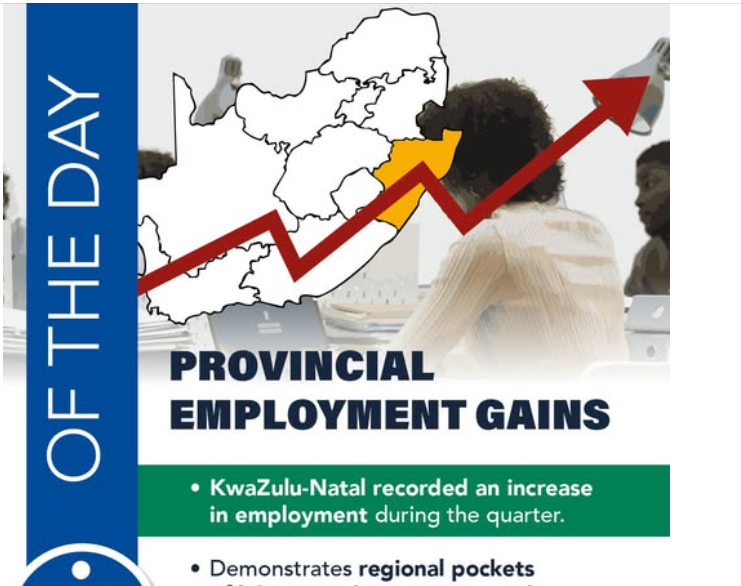

Labour market conditions improve modestly, but employment pressures remain elevated
1. Executive summary
eThekwini’s labour market showed modest signs of improvement in the first quarter of 2026, with the official unemployment rate declining to 22.3 per cent from 24.1 per cent in the previous quarter. The number of unemployed persons decreased by approximately 42 000 quarter-on-quarter, while employment levels remained relatively stable.
Despite this improvement, labour market conditions remain fragile. The labour force contracted during the quarter, suggesting that some individuals exited active job searching amid ongoing economic pressures. Compared to the same period in 2025, the unemployment rate was still marginally higher, indicating that the metro has not yet fully recovered to pre-2025 labour market conditions.
The latest figures suggest that while short-term labour market pressures eased in early 2026, the broader employment environment remains constrained by weak economic growth, infrastructure pressures, and subdued business activity.
2. National and Local Context
South Africa’s labour market remained under pressure in the first quarter of 2026 as economic growth continued to underperform relative to employment needs. Nationally, weak household demand, infrastructure bottlenecks, logistics constraints and elevated business costs continued to affect labour absorption across key sectors.
Within this environment, eThekwini experienced a modest improvement in labour market indicators. However, employment growth remained insufficient to significantly reduce unemployment on a sustained basis. The data continues to reflect a labour market characterised by volatility, uneven recovery patterns, and elevated levels of labour underutilisation.
3. What the eThekwini Labour Market Data Shows
 Source: Authors’ computation
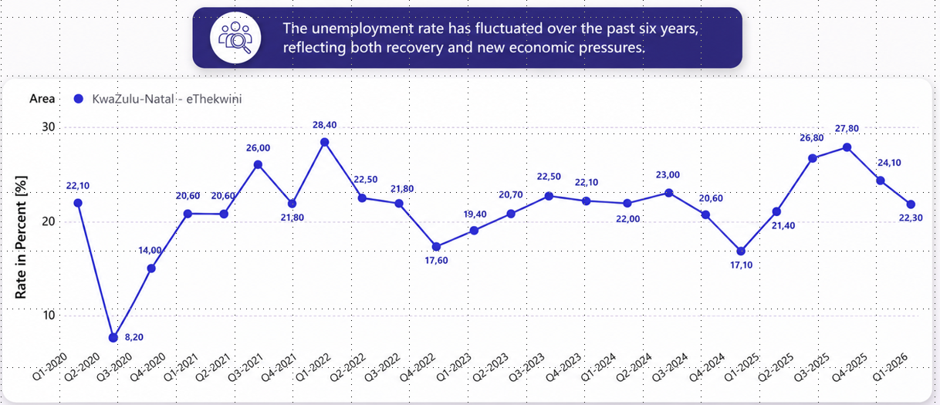
The unemployment trend shows that eThekwini’s labour market has experienced significant fluctuations over the past six years, reflecting both recovery periods and renewed economic pressures. After declining sharply during the pandemic period, the unemployment rate increased again during 2021 and 2022 before moderating through parts of 2023 and 2024.
The metro recorded a renewed increase in unemployment during mid-2025, with the rate peaking at 27.8 per cent in the third quarter of 2025 before easing to 22.3 per cent in the first quarter of 2026.
The latest decline suggests improving labour market conditions relative to the second half of 2025. However, the unemployment rate remains above levels recorded in early 2020, highlighting the persistence of structural employment challenges within the metro economy.
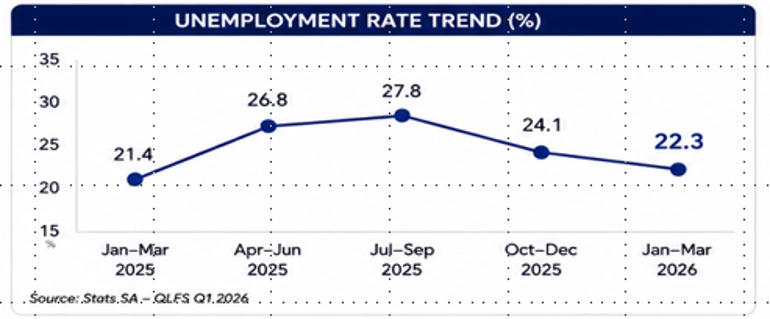
Quarterly data shows that the unemployment rate declined consistently after reaching a recent peak during the third quarter of 2025. Between the fourth quarter of 2025 and the first quarter of 2026, the unemployment rate fell from 24.1 per cent to 22.3 per cent.
This improvement was mainly driven by a reduction in the number of unemployed persons rather than strong employment growth. The labour force declined by approximately 51 000 individuals during the quarter, indicating that some discouraged work-seekers may have exited the labour market.
Although the short-term trend is positive, the labour market remains vulnerable to slower economic activity and limited employment creation across productive sectors.
4. Labour Force and Employment Dynamics
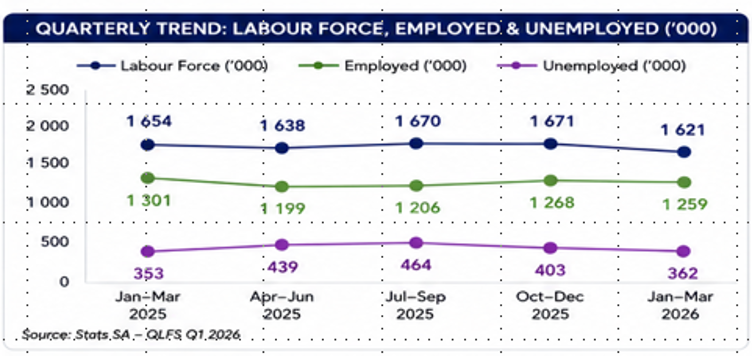
The labour force declined from approximately 1.67 million persons in the fourth quarter of 2025 to 1.62 million in the first quarter of 2026. Employment also declined marginally by approximately 9 000 jobs over the quarter, while the number of unemployed persons fell by around 42 000.
The decline in unemployment alongside a shrinking labour force suggests that labour market improvements were partly linked to reduced participation rather than broad-based employment expansion. This is further reflected in the labour force participation rate, which declined from 61.2 per cent to 59.1 per cent during the quarter.
At the same time, the number of persons outside the labour force increased significantly, rising by approximately 60 000 quarter-on-quarter and by 72 000 compared to the same quarter in 2025.
These trends indicate that while headline unemployment improved, underlying labour market pressures remain significant.
5. Labour Market Indicators
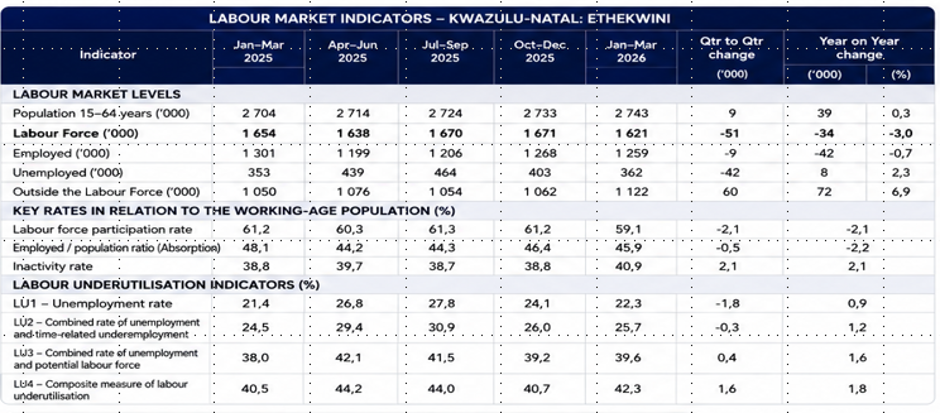
The broader labour market indicators continue to reflect elevated labour underutilisation across the metro.
Key indicators show:
- The official unemployment rate (LU1) declined to 22.3 per cent in Q1 2026.
- The expanded unemployment rate (LU3), which includes discouraged work-seekers, increased to 39.6 per cent.
- The composite labour underutilisation rate (LU4) rose to 42.3 per cent.
- The employment-to-population ratio declined from 46.4 per cent to 45.9 per cent quarter-on-quarter.
These indicators suggest that while the official unemployment rate improved, broader labour market conditions remain weak, particularly when accounting for discouraged workers and underutilised labour.
6. What This Means for eThekwini
The first quarter 2026 labour market data presents a mixed picture for eThekwini. On the positive side, the official unemployment rate declined, and the number of unemployed persons eased from the elevated levels recorded during 2025.
However, the improvement was accompanied by declining labour force participation and a growing number of economically inactive persons. This suggests that labour market recovery remains fragile and not yet broad-based.
For the metro economy, the data reinforces the importance of strengthening economic sectors with high employment absorption potential, including manufacturing, logistics, tourism, construction and small business development.
Investment attraction, infrastructure reliability, freight efficiency and support for local enterprise development remain critical to improving labour market outcomes over the medium term.
The challenge for 2026 will therefore be to convert modest labour market stabilisation into sustained employment growth capable of reducing both unemployment and labour underutilisation across the metro.