

Quarterly Labour Force Survey – Second Quarter 2026
South Africa’s labour market remained under pressure in the second quarter of 2026, but eThekwini recorded a notably different trajectory. While the national and KwaZulu-Natal unemployment rates increased between the first and second quarters, eThekwini experienced employment growth, a reduction in unemployment and an improvement in its absorption rate.
Statistics South Africa’s Quarterly Labour Force Survey (QLFS) for Q2 2026 shows that South Africa’s official unemployment rate increased from 32.7% in Q1 2026 to 33.6% in Q2 2026, an increase of 0.9 percentage points. Nationally, the number of unemployed people increased by 345,000, while employment declined by 16,000 to approximately 16.7 million.
The picture in KwaZulu-Natal was similarly challenging. However, eThekwini moved in the opposite direction, with the metro’s unemployment rate falling from 22.3% to 21.2%, alongside an increase of approximately 30,000 employed people.
National Labour Market Remains Under Pressure
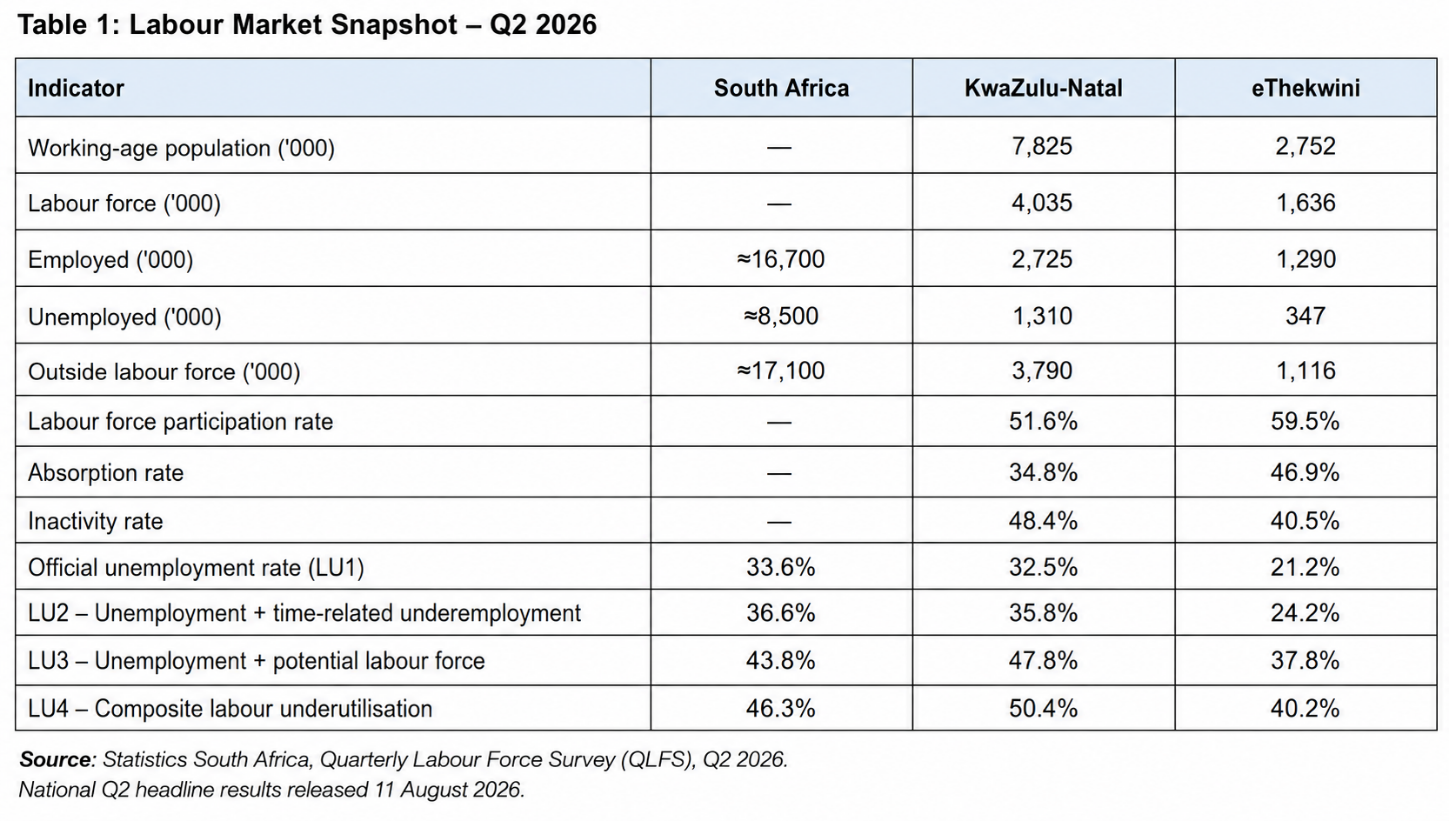
South Africa entered Q2 2026 with continued labour-market challenges. The national labour force increased by approximately 329,000 people, while the number of unemployed people rose by 345,000. Employment declined by approximately 16,000 over the quarter. These movements pushed the official unemployment rate up by 0.9 percentage points to 33.6%.
The broader measures of labour underutilisation reinforce the extent of the challenge. Nationally, the combined unemployment and time-related underemployment rate (LU2) increased to 36.6%, while LU3 increased to 43.8%. The broad composite measure of labour underutilisation (LU4) remained at 46.3%.
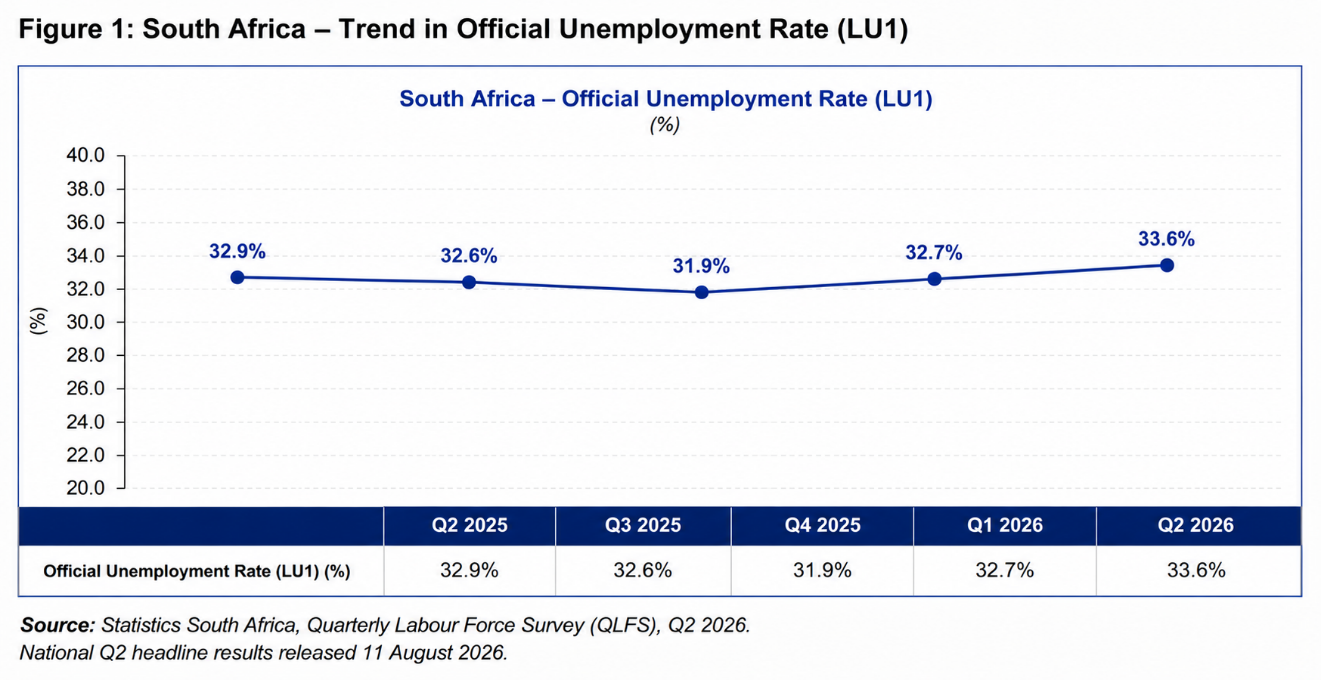
National unemployment declined through much of 2025 before reversing direction in 2026. The increase to 33.6% in Q2 2026 indicates renewed pressure on the national labour market.
KwaZulu-Natal Records Higher Unemployment
KwaZulu-Natal also experienced a deterioration in labour-market conditions during Q2 2026. The provincial labour force increased from approximately 3.956 million in Q1 to 4.035 million in Q2, an increase of approximately 79,000 people. Employment increased only marginally, from approximately 2.722 million to 2.725 million, while the number of unemployed people increased by approximately 76,000, from 1.234 million to 1.310 million.
Consequently, KwaZulu-Natal’s official unemployment rate increased by 1.3 percentage points, from 31.2% in Q1 2026 to 32.5% in Q2 2026. The provincial absorption rate declined slightly from 34.9% to 34.8%, while the labour force participation rate increased from 50.7% to 51.6%. This suggests that more people entered or returned to the labour market during the quarter, but employment growth was insufficient to absorb the additional labour supply.
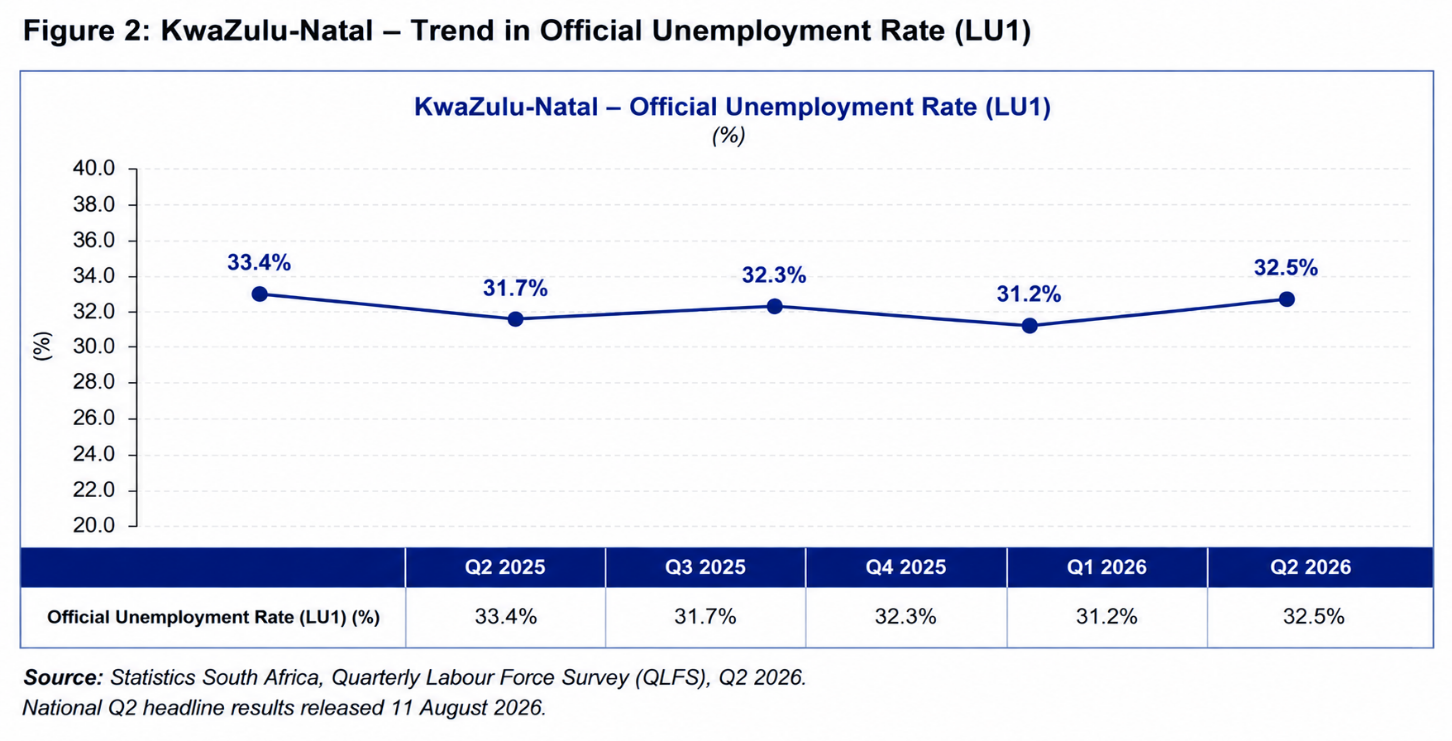
KwaZulu-Natal’s unemployment rate increased in Q2 2026 as growth in the labour force significantly exceeded employment growth.
eThekwini Moves Against the National and Provincial Trend
The most notable result for Durban is the improvement in eThekwini’s labour market. The metro’s working-age population increased by approximately 9,000 people, from 2.743 million in Q1 2026 to 2.752 million in Q2 2026. The labour force increased by approximately 16,000, reaching 1.636 million.
Importantly, employment increased by approximately 30,000, from 1.259 million to 1.290 million. At the same time, the number of unemployed people decreased by approximately 15,000, from 362,000 to 347,000.
As a result, eThekwini’s official unemployment rate declined from 22.3% to 21.2%, representing an improvement of 1.1 percentage points quarter-on-quarter. The improvement was also evident in the employment-to-population ratio, or absorption rate, which increased from 45.9% to 46.9%. The labour force participation rate increased moderately from 59.1% to 59.5%, while the inactivity rate declined from 40.9% to 40.5%.
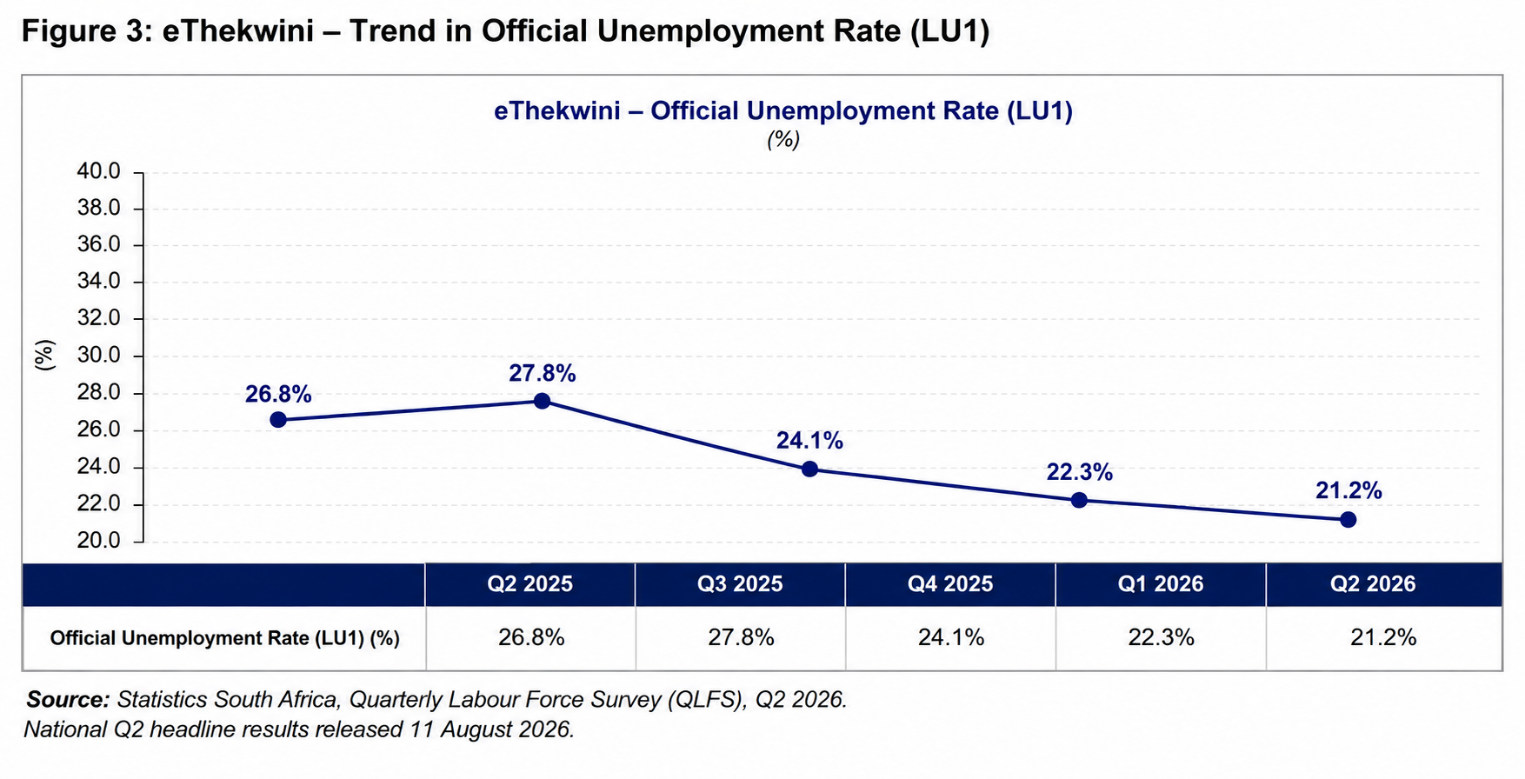
eThekwini’s unemployment rate has declined substantially since its Q3 2025 peak of 27.8%, reaching 21.2% in Q2 2026. Employment increased by approximately 30,000 during the latest quarter, while unemployment declined by approximately 15,000.
Figures are rounded. National headline figures are reported by Statistics South Africa; provincial and metro figures are drawn from QLFS Q2 2026 Table 2.3 supplied for this data story
eThekwini Outperforms on Key Labour-Market Indicators
The Q2 results show a significant difference between eThekwini and the broader provincial and national labour markets. At 21.2%, eThekwini’s official unemployment rate was 11.3 percentage points below KwaZulu-Natal’s 32.5% and 12.4 percentage points below the national rate of 33.6%.
The metro also recorded a considerably stronger absorption rate. Approximately 46.9% of eThekwini’s working-age population was employed, compared with 34.8% in KwaZulu-Natal. This 12.1 percentage-point difference suggests that eThekwini continues to provide a comparatively stronger concentration of employment opportunities within the provincial economy.
The broader labour-underutilisation measures nevertheless show that unemployment alone does not capture the full extent of labour-market pressure. eThekwini recorded an LU4 rate of 40.2% in Q2 2026. Although substantially below KwaZulu-Natal’s 50.4%, this indicates that a significant share of the metro’s potential workforce remains either unemployed, underemployed or marginally attached to the labour market.
A Strong Quarter, but the Trend Should Be Interpreted Carefully
The Q2 2026 results provide an encouraging signal for Durban. Employment increased by approximately 30,000 quarter-on-quarter and 90,000 year-on-year, while the number of unemployed people declined by approximately 15,000 quarter-on-quarter and 92,000 year-on-year.
The unemployment rate consequently declined from 26.8% in Q2 2025 to 21.2% in Q2 2026, an improvement of 5.6 percentage points over the year.
The absorption rate also increased by 2.7 percentage points year-on-year, from 44.2% to 46.9%.
These indicators collectively suggest that the improvement in eThekwini was not driven solely by people leaving the labour force. Employment itself expanded, while the labour force participation rate also increased slightly during the latest quarter.
Nevertheless, quarterly metropolitan labour-market estimates can be volatile and should therefore be interpreted alongside longer-term trends and complementary economic indicators. The sustainability of the improvement will depend on whether employment gains continue over subsequent quarters.
What Does This Mean for Durban?
The Q2 2026 results suggest that eThekwini entered the middle of 2026 with comparatively stronger labour-market momentum than both KwaZulu-Natal and South Africa.
For economic policy, the priority is to translate this improvement into a sustained employment trajectory. Continued investment attraction, infrastructure delivery, support for productive sectors, business retention and expansion, skills development and improved conditions for private-sector investment will remain important to strengthening employment outcomes.
The decline in unemployment is encouraging, but the broader underutilisation indicators demonstrate that significant labour-market challenges remain.
Conclusion
Durban’s labour market strengthened in Q2 2026: employment increased by approximately 30,000, unemployment declined by approximately 15,000, and the official unemployment rate fell to 21.2%. This improvement occurred while unemployment increased at both provincial and national levels.