
1. Executive summary
The eThekwini economy recorded modest growth during the first quarter of 2026, supported by continued expansion in the finance, trade, transport, mining and agricultural sectors. Despite ongoing weakness in manufacturing, overall economic activity remained resilient amid a challenging national and global economic environment.
Using seasonally adjusted and annualised GDP estimates from S&P Global Regional eXplorer, eThekwini’s GDP at market prices increased from approximately R580.4 billion in Q4 2025 to R582.1 billion in Q1 2026, representing quarter-on-quarter growth of approximately 0.3%.
The results suggest that while economic activity continues to expand, growth remains uneven across sectors. Service-oriented sectors continue to outperform goods-producing industries, reflecting broader structural trends within both the local and national economy.
Economic Performance in Q1 2026
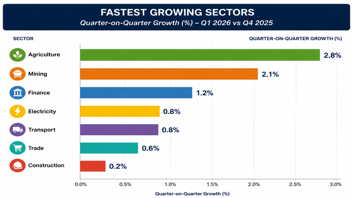
The eThekwini economy expanded by approximately R1.7 billion during the first quarter of 2026. Of the nine productive sectors, seven recorded positive growth while two sectors experienced marginal contractions.
Source: Authors’ computation
Agriculture recorded the strongest growth during the quarter, benefiting from improved production conditions. Although the sector contributes a relatively small share to the overall metro economy, it delivered the fastest rate of expansion.
The finance sector remained the largest contributor to economic growth. Output increased from approximately R108.8 billion in Q4 2025 to R110.1 billion in Q1 2026, reflecting continued strength in financial and business services activity.
Trade and transport also recorded positive growth, supported by consumer activity, tourism-related demand and Durban’s strategic position as South Africa’s leading logistics and port hub.
Mining activity expanded by approximately 2.1 per cent during the quarter, albeit from a relatively small economic base.
2. Sectors Under Pressure
Manufacturing remained the weakest-performing sector in the first quarter of 2026, declining by approximately 1.0 per cent quarter-on-quarter and being the largest drag on overall economic growth.
Community services recorded a marginal contraction of approximately 0.1 per cent, indicating broadly stable but subdued activity within the sector. While the electricity and construction sectors remained relatively weak, both recorded modest positive growth during the quarter, increasing by approximately 0.8 per cent and 0.2 per cent, respectively. These outcomes suggest tentative stabilisation rather than continued contraction.
The continued weakness in manufacturing reflects ongoing challenges associated with logistics constraints, elevated production costs, energy-related pressures and subdued domestic demand.
3. Sector Contribution to eThekwini GDP
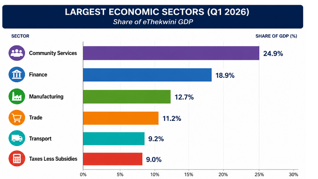
The structure of the eThekwini economy remains dominated by service sectors
Source: Authors’ computation
Together, Community Services, Finance and Manufacturing account for more than half of total economic activity in the metro economy.
The finance sector remains a key driver of growth and resilience, while manufacturing continues to play an important role despite recent output declines.
4. What This Means for eThekwini
The first quarter 2026 GDP results present a cautiously positive picture for the metro economy.
On the positive side:
- Economic activity continued to expand.
- Finance, trade, transport, mining and agriculture all recorded positive growth.
- Electricity and construction showed signs of stabilisation.
- The metro avoided an overall economic contraction.
However:
- Manufacturing remains under significant pressure.
- Community services activity was largely stagnant.
- Growth remains below levels required to materially reduce unemployment and accelerate broad-based economic development.
Looking ahead, improving logistics efficiency, strengthening infrastructure reliability, supporting industrial competitiveness and accelerating investment attraction will be critical to achieving stronger and more inclusive economic growth.
5. Key Message
eThekwini’s economy grew by approximately 0.3 per cent in the first quarter of 2026. Growth was primarily driven by finance, trade, transport and agriculture, while manufacturing remained the principal constraint on stronger economic expansion.
The results indicate continued economic resilience but highlight the need for stronger investment and industrial growth to support sustained job creation.