

Prospecton remains one of Durban’s largest industrial employment centres, supporting approximately 25,463 full-time equivalent jobs across manufacturing, logistics, trade and industrial services. While the precinct continues to be a major source of formal employment, its wage profile reveals both the strengths and the challenges of Durban’s industrial economy. The combination of stable employment, relatively resilient incomes and persistent income disparities highlights the need to focus not only on job creation, but also on improving the quality and inclusiveness of employment.
Figure 1: Median income trends show relatively stable overall earnings, but persistent gender and youth income gaps.
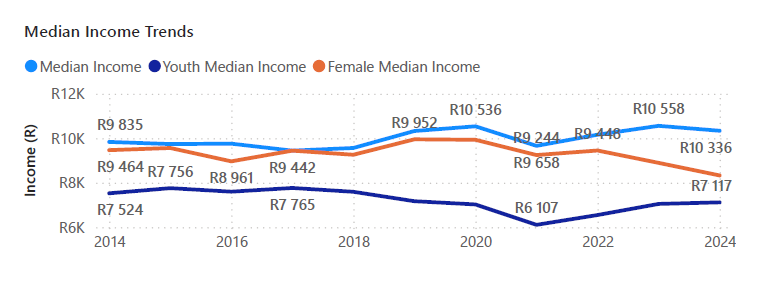
Figure 1 shows that overall median income in Prospecton has remained relatively stable over the past decade, fluctuating around R10,000 per month despite periods of economic disruption. However, the data also highlights persistent income gaps. Male workers earn a median income of approximately R11,000, compared with R8,327 for female workers, while youth workers earn a significantly lower median income of R7,117. Although recent years show some recovery in youth earnings, younger workers continue to earn substantially less than the overall workforce, illustrating the challenges of labour market entry and career progression.
Figure 2: Income distribution by gender illustrates the concentration of workers across different income categories.
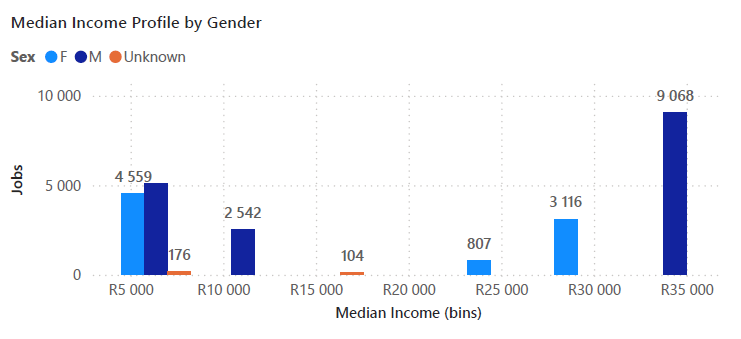
Figure 2 further illustrates the unequal distribution of earnings across the workforce. Most employees are concentrated within the lower and middle income categories, while relatively few workers earn higher incomes. The distribution reflects the structure of Prospecton’s economy, where production, logistics and operational occupations account for a significant share of employment. At the same time, the presence of higher-income positions demonstrates the important contribution of technical, engineering and management occupations within the industrial sector.
Figure 3: Most Prospecton employees are concentrated within the lower and middle wage bands, highlighting opportunities to improve job quality.
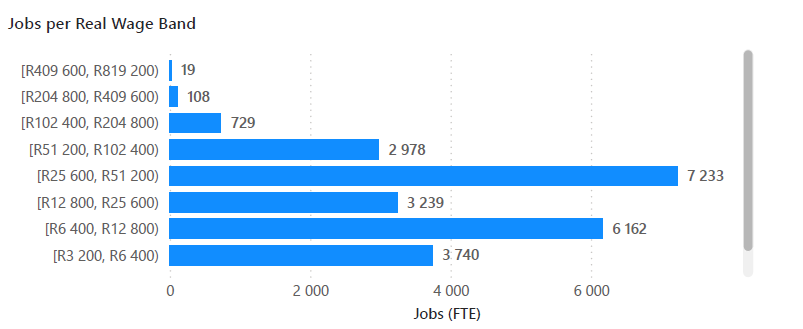
The broader wage distribution presented in Figure 3 reinforces this picture. More than 7,200 workers fall within the R25,600 to R51,200 annual wage band, making it the largest wage category in Prospecton. A further 6,162 workers are employed within the R6,400 to R12,800 annual wage band, while relatively few employees occupy the highest income brackets. This concentration suggests that Prospecton’s industrial economy continues to generate large numbers of operational and semi-skilled jobs, creating employment opportunities while highlighting the need to expand higher-value occupations that offer stronger income growth.
Figure 4: Prospecton’s strategic industrial location underpins its role as one of Durban’s largest employment and manufacturing hubs.
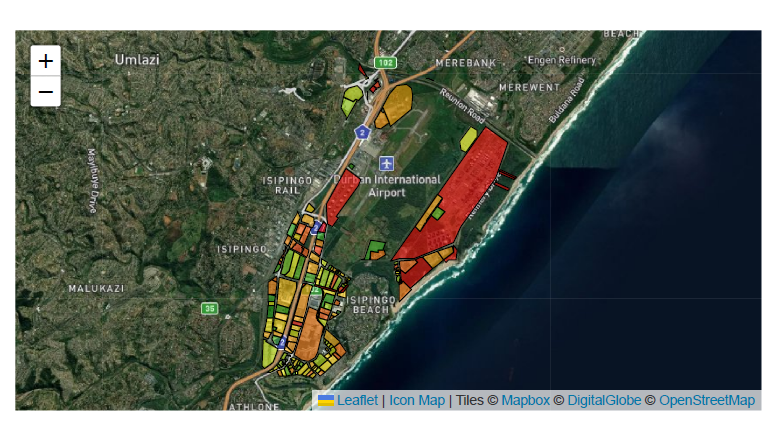
The spatial context shown in Figure 4 helps explain these labour market characteristics. Prospecton’s strategic location adjacent to the Port of Durban, major transport corridors and King Shaka logistics connections has enabled the area to develop into one of South Africa’s leading manufacturing and logistics precincts. The concentration of automotive manufacturers, petrochemical industries, warehouses and industrial facilities continues to attract investment and sustain formal employment, reinforcing Prospecton’s role as a cornerstone of Durban’s industrial economy.
While Prospecton has successfully created thousands of formal jobs, the next phase of industrial development should focus on improving income outcomes. Expanding technical skills development, supporting advanced manufacturing, promoting innovation and increasing opportunities for youth and women in higher-skilled occupations will help ensure that future industrial growth translates into broader prosperity. As Durban pursues inclusive economic development, the quality of employment will become just as important as the quantity of jobs.