


Abstract
Financial sustainability remains one of the most significant challenges facing South African municipalities. Municipalities rely heavily on revenue collected from rates, service charges and other own-source revenues to fund service delivery and infrastructure development. While institutional factors such as billing systems and debt collection policies have been widely studied, less attention has been given to the influence of macroeconomic conditions on municipal revenue performance. This paper investigates the relationship between economic growth, unemployment and municipal revenue collection in eThekwini Municipality.
Using Ordinary Least Squares (OLS) regression, the study examines whether changes in Gross Domestic Product (GDP) growth and unemployment influence the municipal collection rate. The findings indicate that GDP growth has a statistically significant positive effect on collection performance, while unemployment exhibits the expected negative relationship but is not statistically significant. The model explains approximately 55% of the variation in municipal collection rates, suggesting that macroeconomic conditions play an important role in determining municipal financial performance.
The study concludes that municipal revenue forecasting and financial planning should incorporate macroeconomic indicators alongside traditional operational measures. Strengthening local economic growth is likely to improve municipal revenue collection and contribute to long-term financial sustainability.
Keywords: Municipal finance, revenue collection, GDP, unemployment, local government, eThekwini Municipality.
1. Introduction
Municipal revenue collection is fundamental to the financial sustainability of local government. Revenue generated through property rates, electricity, water, sanitation and refuse removal finances the delivery of essential municipal services and capital infrastructure. Declining collection rates increase financial risk, reduce cash flow and constrain the ability of municipalities to fulfil their constitutional mandate.
Municipal collection performance is influenced by both internal and external factors. Internal factors include billing accuracy, debt collection policies, customer service and governance. External factors include economic growth, employment, inflation and business confidence. During periods of economic expansion, households and businesses generally experience higher incomes and are better able to meet their municipal obligations. Conversely, economic downturns often reduce payment capacity and increase municipal debt.
This paper examines whether macroeconomic conditions influence municipal collection performance in eThekwini Municipality. Specifically, it evaluates the extent to which GDP growth and unemployment explain variations in the municipal collection rate.
2. Methodology
The study applies a quantitative research approach using Ordinary Least Squares (OLS) regression.
Municipal revenue collection data were obtained from the eThekwini Municipality. Gross Domestic Product (GDP) estimates were sourced from S&P Global Market Intelligence’s Regional eXplorer (ReX) database, while unemployment data were obtained from Statistics South Africa’s Quarterly Labour Force Survey (QLFS). These datasets were combined to estimate the relationship between macroeconomic performance and municipal revenue collection using Ordinary Least Squares (OLS) regression.
The estimated model is:

where:
Collection Rate = Municipal revenue collection rate (%)
GDP = eThekwini economic growth rate (%)
Unemployment = Municipal unemployment rate (%)
ε = Random error term
The analysis uses quarterly observations obtained from municipal financial records together with economic indicators.
3. Results
Model Performance
The regression results indicate a reasonably strong relationship between municipal collection performance and the explanatory variables.
| Statistic | Result |
| Multiple R | 0.742 |
| R² | 0.551 |
| Adjusted R² | 0.422 |
| Standard Error | 0.027 |
| Observations | 10 |
Approximately 55.1% of the variation in municipal collection performance is explained jointly by GDP growth and unemployment. The adjusted R² of 42.2% indicates moderate explanatory power after accounting for the number of explanatory variables.
The overall model is moderately significant (F = 4.29; p = 0.061). Although slightly above the conventional 5% significance level, the model is statistically meaningful at the 10% level, which is often considered acceptable for exploratory studies with relatively small samples.
Individual Coefficients
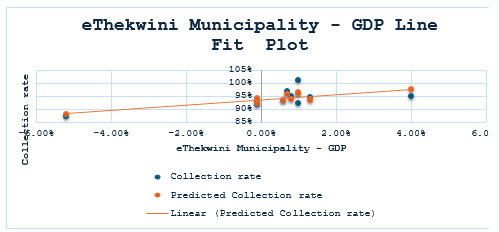
GDP Growth
GDP growth has a positive coefficient of 1.114 and is statistically significant (p = 0.028).
This indicates that a one percentage point increase in economic growth is associated with approximately a 1.1 percentage point increase in the municipal collection rate, holding unemployment constant.
The findings suggest that stronger economic activity improves household income, increases business profitability and enhances the ability of ratepayers to settle municipal accounts.
Unemployment
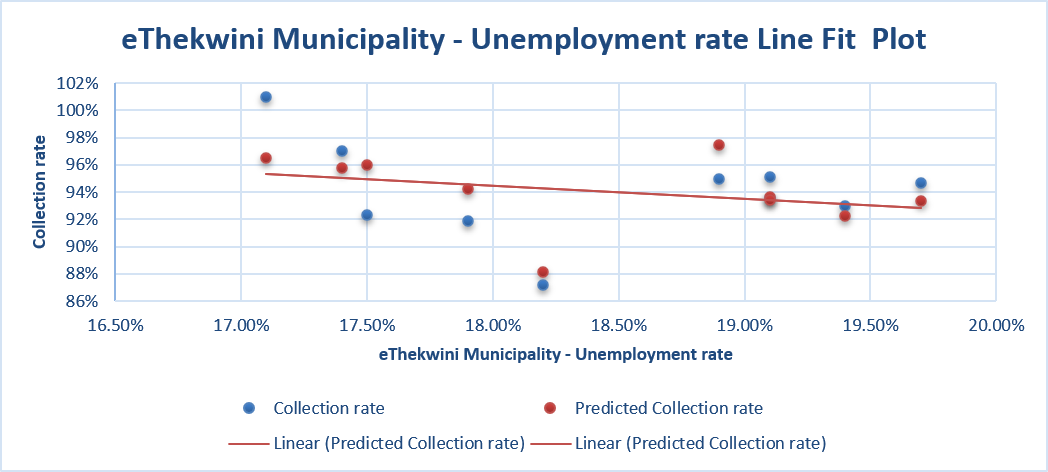
The unemployment coefficient is −1.336, indicating an inverse relationship between unemployment and collection performance.
Although the coefficient has the expected negative sign, it is not statistically significant (p = 0.220). This suggests that unemployment alone does not independently explain municipal collection performance once GDP growth is considered.
Possible explanations include municipal debt management practices, payment arrangements, social grants and other income sources that partially offset labour market conditions.
4. Discussion
The results demonstrate that economic growth is an important determinant of municipal financial performance. Higher levels of economic activity generate employment, increase disposable household income and improve business turnover. These factors collectively enhance the ability of consumers and businesses to pay municipal accounts on time, thereby improving collection performance.
The positive relationship between GDP and municipal collection is consistent with economic theory, which suggests that local government finances are closely linked to regional economic performance.
Although unemployment displays the expected negative relationship, its statistical insignificance suggests that collection performance is influenced by broader economic conditions rather than labour market conditions alone.
The findings imply that municipalities should monitor macroeconomic indicators as part of their revenue forecasting process.
5. Policy Implications
The results have several practical implications for municipal financial management. First, revenue forecasts should incorporate economic growth projections alongside historical collection trends. Second, municipalities should recognise that periods of economic slowdown are likely to reduce collection performance and therefore require stronger cash-flow management.
Third, economic development initiatives aimed at stimulating investment and business growth may also improve municipal financial sustainability by expanding the municipal revenue base. Finally, municipal budgeting should incorporate scenario analysis based on alternative economic growth assumptions to improve fiscal resilience.